
Can I see it?
Of course. Run npm install && npm run dev.
Can you run it?
I started it on port 3001 instead.
Is that the new version?
Let me check.
A seven-message launch button.
A delivery process for AI-built software
Spedito takes a rough idea through planning, coordinated delivery, independent review, and a working demo—with an AI team that gets better every Sprint.
The current state of AI software delivery
Writing code can now begin with a conversation. Naturally, the industry responded by building another stack of developer tooling around it.
01 Have a perfectly good product idea
02 Open a terminal for some reason
03 Install skills for the AI that already knows how to code
04 Add plugins to manage the skills
05 Memorise slash commands because plain English was too easy
06 Arrange tmux panes until your laptop resembles air traffic control
07 Appoint an AI manager to supervise the AI workers
08 Open another terminal to find out why management has stopped responding
Or go all in: create a Rig, assemble a
Convoy, sling some Beads to the
Polecats, ask the Witness to patrol
them, and let the Refinery manage the merge queue.
Spedito
It turns the machinery into a product-delivery workflow. Describe what you want. Refine the Backlog. Approve the Sprint. See what is moving or blocked. Review the working Demo.
One click prepares and launches the reviewed product—no terminal, ports, or setup required.
Can I see it?
Of course. Run npm install && npm run dev.
Can you run it?
I started it on port 3001 instead.
Is that the new version?
Let me check.
A seven-message launch button.
Ticket details
Search for a place and see its current conditions with a seven-day forecast.
3f8d12a
No terminal. No port archaeology. No ambiguity.
A few focused questions turn a rough idea into a prioritised Backlog with clear dependencies.
Let people share stuff.
Done. I added public sharing to every result.
I meant a private link to one saved result.
Understood. The private links never expire.
They should probably expire.
That matters. What should happen when they expire?
Implementation is a surprisingly expensive questionnaire. Great vibes, though.
T21
Define privacy, expiry, and revocation
Ready
T22
Design shared, expired, and unavailable states
Ready · parallel
T23
Build and verify expiring private links
After T21 + T22
The questions happen before implementation. The answers become Tickets, dependencies, and Product knowledge the team can reuse.
Dependencies decide what can start together, what must wait, and when the next wave can begin.
Can you split this up and work in parallel?
Absolutely. I’ll run two agents.
App.tsxApp.tsxTwo agents. One file. Zero coordination.
Separate workspaces. Explicit dependencies. Useful parallelism.
Every change stays tied to its Ticket, its review, and the product result you approve.
Looks good. Commit everything.
Done. I committed all changes.
What changes?
Let me inspect the commit.
Committed first. Understood later.
3f8d12aYour decision is whether the product is right—not whether the branch is clean.
Its memory should compound as structured, verified knowledge—not become another summary of an increasingly enormous chat.
The product memory is now a summary of a summary of a chat.
Product knowledge the whole team can browse, verify, and reuse.
Spedito records what actually happened: changes, checks, decisions, permissions, review findings, and exact revisions.
Implementation is complete and all tests pass.
Which tests?
Let me verify that.
All tests passed. Running them is next.
Progress is something the Product Owner can inspect.
Interrupted delivery recovers with its Ticket, Conversation, workspace, decisions, and previous evidence intact.
Continue where we left off.
Certainly. Could you remind me what we were doing?
A fresh start, whether you wanted one or not.
Resuming from the last confirmed checkpoint.
It continues the work. It does not pretend to start it again.
Spedito uses Codex’s built-in macOS sandbox. Each product is its own workspace, and each delivery agent is scoped to one isolated Ticket workspace.
Somehow, you became the sandbox.
The agent needs access outside its current Ticket workspace.
Verify the provider’s current documentation and privacy terms.The safe boundary exists before the first prompt is sent.
Yes. Spedito runs on your Mac and uses your local Codex. Product state, workspaces, Work logs, and Product knowledge stay local. Code changes are made in an ordinary local Git repository, so you can push it to a remote or share it yourself whenever you like. Network access is off unless you explicitly allow it. Built-in remote connection and sync are planned for a later version.
Yes. The complete app source is available under the Apache 2.0 licence. You can inspect how Spedito works, audit its sandbox and permission boundaries, build it yourself, report issues, or contribute improvements on GitHub.
For now: Codex on Apple silicon Macs running macOS 14 or later. Spedito uses Codex App Server because it provides a proper two-way integration: structured live activity, diffs, questions, approvals, usage, and resumable sessions—without scraping a terminal. Future Agent Client Protocol (ACP) support is intended to broaden the provider range, but only where a runtime can meet the same sandbox, approval, recovery, and audit guarantees.
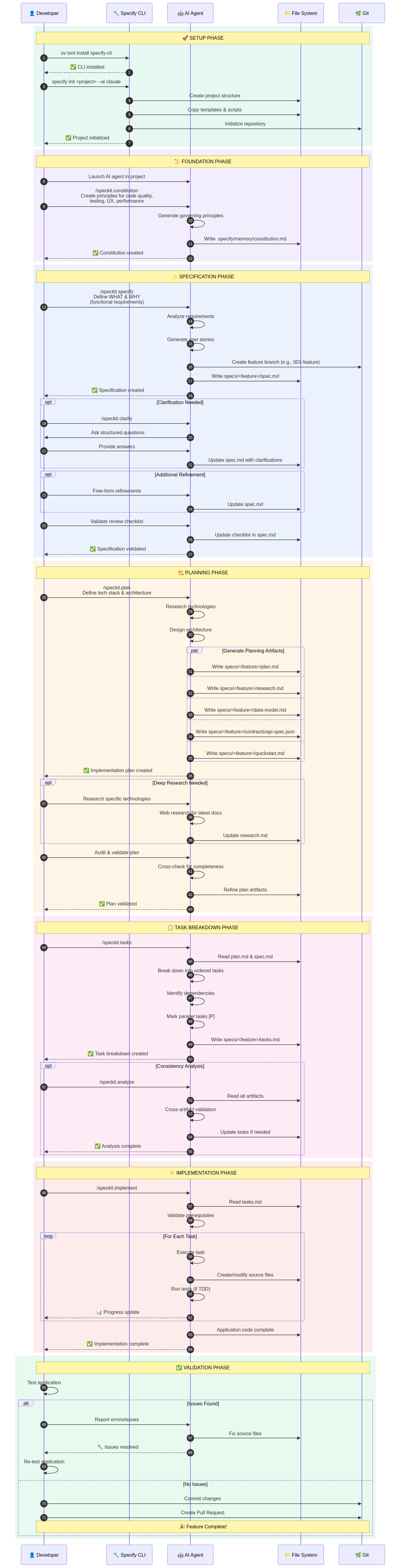
Spec Kit turns “build this” into a nine-command constitutional ceremony:
/speckit.constitution
/speckit.specify
/speckit.clarify
/speckit.plan
/speckit.checklist
/speckit.tasks
/speckit.analyze
/speckit.implement
/speckit.converge
When the software-delivery process needs a 146-line sequence diagram and its own scroll bar, the process may have become the product. If this diagram sparks joy, Spedito may feel alarmingly straightforward.
No. Spedito handles isolated Ticket workspaces, revisions, review candidates, integration, checks, and Demo preparation underneath the product workflow.
The default team includes a Business Analyst, UX Designer, Tech Lead, and Implementer. You can tune their models, effort, and instructions for each product.
Yes—when the dependency graph says they can. Independent Tickets run in separate workspaces; dependent work waits; integration is coordinated and reviewed.
The Backlog, decisions, Work logs, Product knowledge, run state, and Ticket workspaces are durable. Interrupted work can resume from the same product context.
No. AI can ask focused questions, propose scope, identify dependencies, and deliver work. Consequential decisions, access, Sprint scope, and acceptance remain yours.
After the exact version of the change has passed its checks, received independent review, integrated cleanly into the current product, produced a working Demo, and been accepted by the Product Owner.
AI writes the code. Spedito runs the delivery process.
Apache 2.0 · macOS 14+ · Requires Codex